
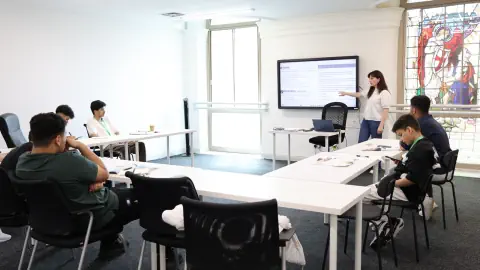
Two professional situations strike particular fear into international professionals working in English: the meeting and the presentation. In a meeting, the conversation moves fast, people interrupt, and you have to find the right moment and the right words to contribute. In a presentation, all eyes are on you as you speak at length to a room. Both can feel intimidating in a second language — and both, reassuringly, run on predictable structures and phrases you can learn. Master those, and you can contribute and present in English with genuine confidence.
In short: to succeed in English meetings, learn phrases for giving opinions, agreeing and disagreeing politely, interrupting and asking questions, so you can contribute at the right moment. For presentations, use a clear structure (introduction, body, conclusion) with signposting language to guide your audience, and prepare and practise thoroughly. Both rely on predictable, learnable language and on preparation, which turns anxiety into confidence.
Here are the phrases and techniques for each.
Part 1: English for meetings
Meetings are a core part of professional life, and contributing well to them is a real skill — especially in a second language, where the challenge isn't only what to say but when and how to enter a fast-moving discussion. Having ready phrases for each function removes much of the difficulty.
Giving your opinion
When you want to contribute your view, useful phrases include:
- "In my opinion..." / "I think that..." / "From my point of view..."
- "It seems to me that..."
- "I'd like to suggest that..."
- "What I'd propose is..."
These let you state your view clearly and professionally. Having them ready means you can contribute the moment you have something to add, rather than hesitating while you search for how to begin.
Agreeing and disagreeing politely
Meetings involve agreement and disagreement, and doing both politely is important — especially in British professional culture, where disagreement is expected but courteous:
- Agreeing: "I agree with...", "That's a good point.", "Exactly.", "I'd go along with that."
- Disagreeing (politely): "I see your point, but...", "I'm not sure I agree, because...", "I take your point; however...", "That's true, although have we considered...?"
Notice how the polite disagreements acknowledge the other view before offering yours — this softens the disagreement and keeps the discussion collaborative, which is exactly the professional register expected.
Interrupting and entering the discussion
A specific challenge in meetings is getting into a fast conversation without being rude. Polite phrases for interrupting or taking a turn:
- "Sorry to interrupt, but..."
- "Could I just add something here?"
- "Can I come in on that point?"
- "If I could just say something..."
- "Just to build on what [name] said..."
These let you enter the discussion courteously and at the right moment. Learning a couple gives you the confidence to contribute rather than staying silent because you couldn't find a way in.
Asking questions and clarifying
In meetings you often need to check understanding or ask for more, and doing so clearly is valuable (and shows engagement):
- "Could you clarify what you mean by...?"
- "Just to make sure I understand, are you saying...?"
- "Could you give an example?"
- "What's the next step?" / "Who will take this forward?"
Asking for clarification is a strength, not a weakness — it ensures you've understood and keeps the meeting productive. In a second language especially, never hesitate to use these.
Part 2: English for presentations
Presentations are different — instead of entering a fast discussion, you speak at length to an audience, which means the challenges are structure, clarity and confidence. The good news is that a good presentation follows a clear, learnable shape, guided by signposting language.
Structure your presentation clearly
Like an essay, a presentation has three parts, and making the structure clear helps both you and your audience:
Introduction: greet the audience, introduce yourself and your topic, and outline what you'll cover. ("Good morning, everyone. Today I'm going to talk about... I'll cover three main areas: first..., then..., and finally...")
Body: present your main points in a logical order, one at a time, with supporting detail. This is the substance of your talk.
Conclusion: summarise your key points, state your main message or recommendation, and close. ("So, to summarise..., the key takeaway is... Thank you. I'm happy to take any questions.")
Telling the audience your structure at the start (and signposting as you go) makes your presentation easy to follow — and, helpfully, gives you a clear path through it, which calms nerves.
Use signposting language
Signposting — language that guides the audience through your presentation — is the key skill that makes a talk clear and professional. These phrases act like road signs:
- Starting / outlining: "Today I'm going to...", "I'll cover three main points...", "Let's begin with..."
- Moving between points: "Firstly...", "Moving on to...", "Now let's turn to...", "This brings me to..."
- Adding emphasis: "The key point here is...", "Importantly...", "What's crucial is..."
- Referring to visuals: "As you can see on this slide...", "This graph shows..."
- Concluding: "To sum up...", "In conclusion...", "The main message is..."
- Inviting questions: "I'd be happy to answer any questions.", "Does anyone have any questions?"
Using signposting throughout transforms a presentation from a confusing stream of information into a clear, guided journey — and it's one of the easiest professional skills to learn and apply.
Prepare, practise and handle questions
Beyond language, a few principles make presentations succeed:
- Prepare thoroughly. Know your material and structure well. Confidence comes largely from preparation.
- Practise out loud. Rehearse your presentation aloud, ideally several times, ideally to someone. This turns your script into ready language, reveals where you stumble, and builds confidence — especially valuable in a second language.
- Keep it clear and simple. Use clear, not over-complicated, language; speak at a measured pace; and don't overcrowd your slides. Clarity impresses more than complexity.
- Manage nerves. Speak slowly, breathe, and remember it's fine to pause. The audience wants you to do well.
- Handle questions calmly. Prepare for likely questions; if you don't understand one, politely ask the person to repeat or clarify it; and it's fine to say "That's a good question, let me think for a moment." You don't have to know everything.
Turning preparation into confidence
The thread through both meetings and presentations is the same: success comes from learnable language plus preparation, not from being a perfect native speaker. A professional who has learned the key phrases, prepared their points, and practised will contribute to meetings and deliver presentations far better than a more fluent colleague who walks in unprepared. These are skills, and skills can be built.
This is exactly the practical, professional communication that Business English develops. At Yorkshire College, students build these real-world skills — contributing to meetings, delivering presentations, using professional language with confidence — and practise them in a supportive setting with the personal feedback that small classes allow, where you can actually rehearse speaking up and presenting. For any international professional, these are among the most directly career-enhancing English skills you can develop. Learn the phrases, prepare well, practise, and you can hold your own in any meeting and present with confidence. (See also our guides to Business English and English for job interviews.)
Frequently asked questions
How can I speak confidently in English meetings? Learn ready phrases for the key functions — giving opinions ("In my opinion..."), agreeing and disagreeing politely ("I see your point, but..."), interrupting courteously ("Sorry to interrupt, but..."), and clarifying ("Could you clarify what you mean by...?"). Having these prepared lets you contribute at the right moment, and confidence grows with preparation and practice.
How do I interrupt politely in a meeting in English? Use polite phrases such as "Sorry to interrupt, but...", "Could I just add something here?", "Can I come in on that point?", or "Just to build on what [name] said...". These let you enter a fast-moving discussion courteously and at the right moment, rather than staying silent.
How do I structure a presentation in English? Use three clear parts: an introduction (greet, introduce yourself and your topic, outline what you'll cover), a body (your main points in logical order with detail), and a conclusion (summarise, state your main message, invite questions). Telling the audience your structure at the start and signposting throughout makes it easy to follow.
What is signposting in a presentation? Signposting is language that guides your audience through your talk, such as "Firstly...", "Moving on to...", "The key point here is...", "To sum up...", and "I'd be happy to answer questions". It acts like road signs, making your presentation clear and professional, and it also helps you keep your place.
How can I prepare for presentations in a second language? Know your material and structure well, and practise out loud several times, ideally to someone, which turns your script into ready language and builds confidence. Keep your language clear and simple, speak at a measured pace, prepare for likely questions, and remember it's fine to pause or ask for a question to be clarified.
Contribute and present in English with confidence. Explore Business English at Yorkshire College or request a quote.